Think about the last marketing campaign that caught your attention.
Chances are, you didn’t respond because you saw one advertisement. More likely, you encountered the same message several times in different places. Maybe you noticed a social media post, received an email a few days later, passed a sign in a storefront, and finally decided to act after seeing a reminder in your mailbox.
That’s how most buying decisions happen.
Customers rarely move from awareness to action in a single step. Instead, they build familiarity over time, with each interaction reinforcing the last. Yet many businesses still approach print marketing as though one piece has to accomplish everything on its own.
A postcard is expected to introduce the offer, explain the details, create urgency, and generate a sale. A brochure is asked to tell the company’s entire story. A flyer is loaded with every product, service, promotion, and contact method the business can think of.
When one piece is expected to carry the entire campaign, the message often becomes crowded, confusing, and easy to overlook.
The strongest marketing campaigns take a different approach. They begin with one clear idea, then use multiple touchpoints to deliver that idea naturally over time.
One Message, Different Moments
Imagine your business is planning a customer appreciation event.
You could create a postcard announcing the event and hope it lands on someone’s kitchen counter at exactly the right moment. Sometimes that works.
But now picture the same campaign unfolding a little differently.
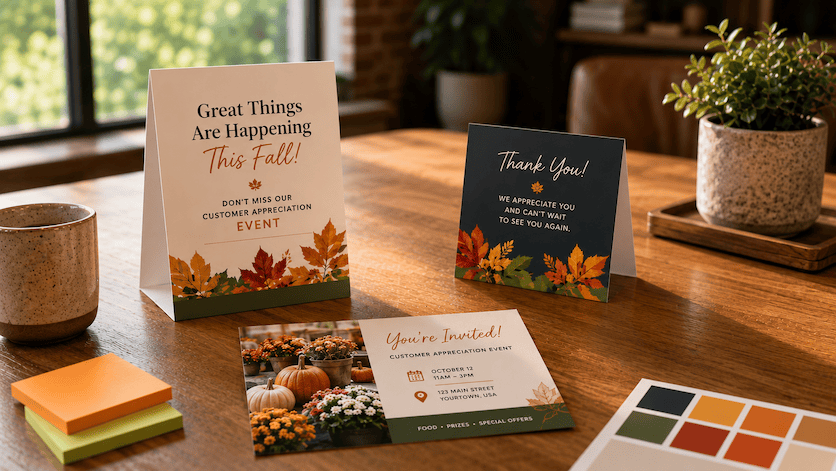
- The postcard introduces the event and invites customers to save the date.
- A poster near your entrance reminds visitors every time they walk through the door.
- A table tent or counter card catches their attention while they’re already waiting to order, check out, or ask a question.
- A brochure provides additional details for anyone who wants to learn more, and
- A follow-up postcard thanks attendees while inviting them back for the next promotion.
No single piece tells the entire story because it doesn’t have to.
Each one has a specific role, and together they create a consistent experience that feels intentional rather than repetitive.
This is where many successful campaigns separate themselves. They don’t rely on one perfect marketing piece. They build momentum through a series of well-timed impressions.
Every Piece Has a Purpose
One of the biggest planning mistakes businesses make is treating every printed piece like a miniature website. The temptation is understandable. If you’re investing in print, why not include one more product, one more offer, one more testimonial, and one more QR code?
The problem is that customers don’t consume every piece the same way.
Someone glancing at a table tent while waiting for lunch has different expectations than someone reading a brochure at home. A poster in a storefront has only a few seconds to capture attention, while a postcard arriving in the mail has a little more time to introduce an idea.
When each piece is designed for the moment in which it will be seen, the campaign becomes stronger as a whole. Instead of repeating the same information everywhere, each touchpoint contributes something new while reinforcing the same central message.
Repetition Builds Confidence
There’s another reason coordinated campaigns outperform isolated marketing pieces.
People are naturally cautious. Whether they’re choosing a new restaurant, hiring a contractor, or signing up for a service, they rarely make important decisions after a single interaction.
Repeated exposure creates familiarity, and familiarity creates confidence.
That’s why a customer who briefly notices your postcard may pay more attention when they see the same message displayed in your business a week later. By the time they receive a follow-up offer or speak with your staff, your promotion already feels familiar.
None of those individual moments is especially powerful on its own. Together, they make the decision easier.
Start With the Campaign, Not the Product
Before deciding whether you need postcards, brochures, table tents, or posters, ask a different question.
How will customers experience this campaign from beginning to end?
That simple shift changes the planning process.
Instead of choosing a product and trying to make it accomplish everything, you’re building a sequence of touchpoints that support one another. Each printed piece has a clear purpose, each appearance feels intentional, and the campaign becomes much easier for customers to notice, remember, and respond to.
Print is at its best when it isn’t working alone. It’s part of a larger conversation that unfolds over time, meeting customers where they are instead of expecting one piece to do all the heavy lifting.
If you’re planning your next promotion, we’d be happy to help you build a coordinated print campaign that makes every piece work together toward the same goal.


Leave a comment